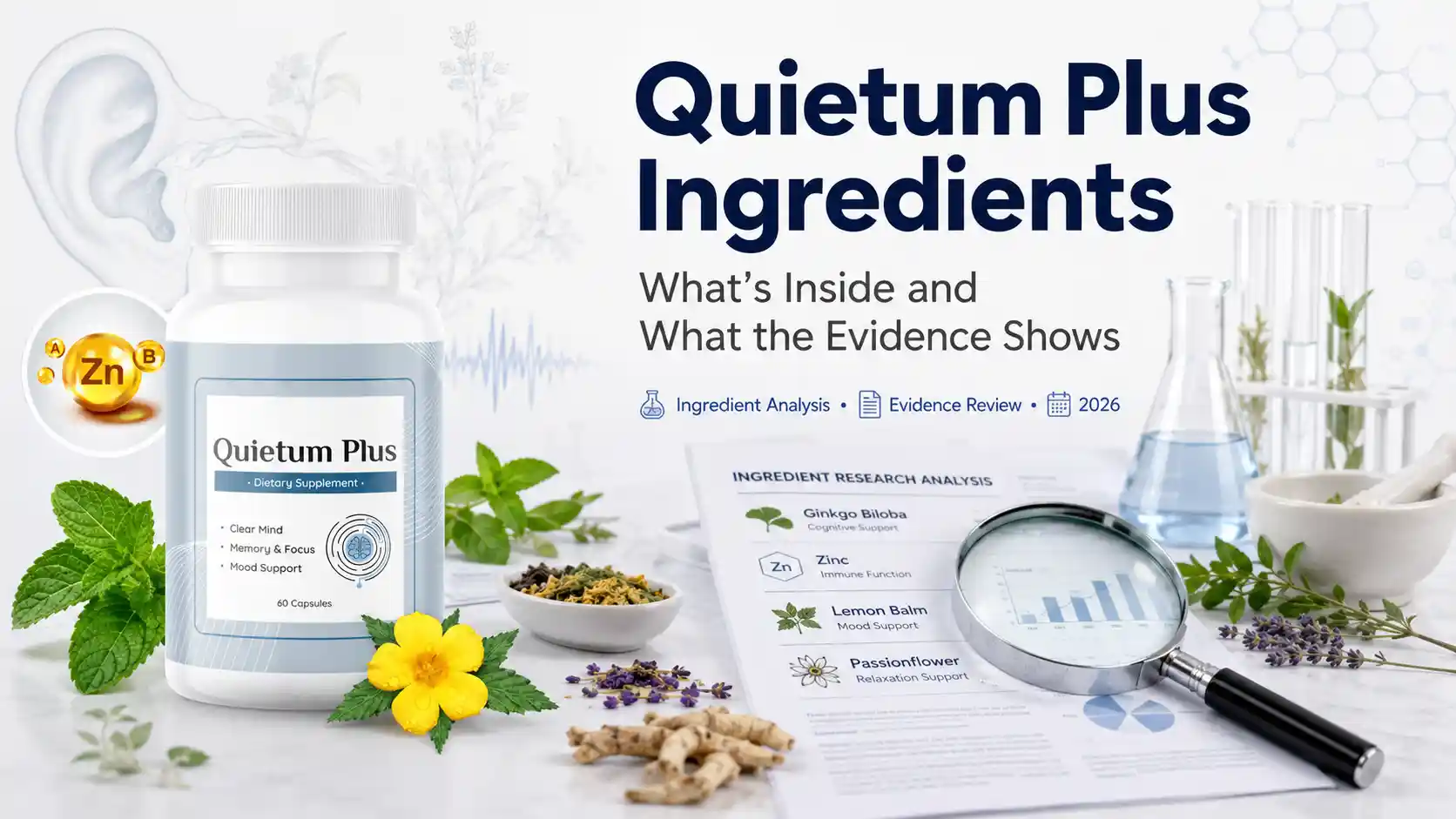
Quietum Plus Ingredients: What’s Inside & What The Evidence Shows?
Quietum Plus ingredients include herbal extracts, vitamins, minerals, amino acids, and black pepper extract.
While several of these ingredients have been studied for their antioxidant, anti-inflammatory, or nerve-supporting properties, no published clinical trials have tested Quietum Plus as a finished formula.
Around 10% to 25% of adults experience tinnitus, yet no dietary supplement has been proven to cure it.
This article breaks down every Quietum Plus ingredient and explains what the current evidence actually shows.
What Are The Ingredients In Quietum Plus?
The maker describes Quietum Plus as a plant-forward blend with supporting nutrients.
Reported formulas have shifted over time, and counterfeit bottles muddy the picture even more, but the components most often listed for the genuine product are below.
| Ingredient | Type | Reported role in the blend |
|---|---|---|
| Mucuna pruriens | Botanical (L-DOPA source) | Nervous system and mood support |
| Maca root | Adaptogen | Energy, circulation, stress balance |
| Epimedium (horny goat weed) | Botanical | Blood flow via icariin |
| Ashwagandha | Adaptogen | Stress and cortisol balance |
| Tribulus terrestris | Botanical | General vitality |
| Dong quai | Botanical | Circulation |
| Ginger root | Botanical | Anti-inflammatory action |
| Damiana | Botanical | Mood and relaxation |
| Catuaba powder | Botanical | Energy and nerve support |
| Sarsaparilla root | Botanical | Antioxidant action |
| Asparagus | Botanical | Mineral content |
| Piperine (black pepper extract) | Bioavailability aid | Helps the body absorb other compounds |
| L-tyrosine | Amino acid | Neurotransmitter building block |
| L-arginine | Amino acid | Nitric-oxide precursor for blood flow |
| Zinc | Mineral | Cell and immune support |
| Vitamins A and B group | Vitamins | Nerve and metabolic support |
Some older labels and review pages also mention yam, fenugreek, motherwort, black cohosh, blessed thistle, hawthorn berry, licorice root, and garlic.
Because the recipe has changed across batches, always read the panel on the bottle you actually receive rather than trusting a generic list online.
Quietum Plus Ingredients Explained One By One
Here is what each part of the formula brings, paired with a straight answer on the research behind it.
Many of these herbs are classic tonic plants with long folk histories but thin clinical data for hearing specifically.
Mucuna Pruriens
This bean is a natural source of L-DOPA, the chemical the body turns into dopamine. Most solid studies on mucuna look at Parkinson’s care and mood, not ears. The link to hearing rests on the idea that healthy nerve signaling helps the ear-to-brain pathway, which is plausible in theory but not proven for tinnitus.
Maca Root
Maca is a Peruvian plant studied for energy, mood, and libido. Some small trials suggest it eases stress and fatigue. No quality human study ties maca to better hearing or quieter tinnitus, so treat any ear-specific claim as marketing rather than fact.
Epimedium (Horny Goat Weed)
Epimedium contains icariin, a compound linked to better blood flow in lab and animal work. Better circulation sounds good for the oxygen-hungry inner ear, yet that connection has not been shown to reduce ringing in people. The evidence stops well short of the hearing benefits the ads suggest.
Ashwagandha
Of the whole list, ashwagandha has some of the better human data, though for stress and cortisol, not ears. Several controlled trials report lower stress markers and improved sleep. Since stress and poor sleep can make tinnitus feel louder, easing them may help you cope, even if the ringing itself stays the same.
Tribulus Terrestris, Damiana, and Catuaba
These three show up as traditional vitality and mood herbs across South American and Asian medicine. Human research on them is limited and mostly unrelated to hearing. Their place in the blend leans on tradition and a general wellness angle rather than ear-focused science.
Dong Quai and Ginger
Dong quai is a circulation herb common in Chinese medicine, while ginger is a well-known anti-inflammatory. Reduced inflammation and steady blood flow are reasonable goals for ear tissue. Even so, no strong trial links either herb to measurable tinnitus relief. Ginger does earn points for being gentle on most stomachs.
Sarsaparilla and Asparagus
Both add antioxidants and trace minerals. Antioxidants help fight the cell stress that can wear down hearing over a lifetime. That is a long-game wellness idea, not a quick fix for ringing ears, and the doses in a single capsule are modest.
Piperine (Black Pepper Extract)
Piperine is the one ingredient with a clear, well-documented job. It improves how the body absorbs other compounds, an effect proven with substances like curcumin. In a blend like this, piperine mainly helps the other parts reach your bloodstream more fully.
L-Tyrosine and L-Arginine
These amino acids support neurotransmitter production and blood vessel function. L-arginine feeds nitric oxide, which relaxes blood vessels and aids flow. Both ideas connect loosely to ear health through circulation and nerve signaling, but neither has hearing-specific trial backing.
Zinc, Vitamin B12, and Friends
Here the science gets more concrete, with a catch. Zinc helped tinnitus only in people who were already zinc-deficient in controlled studies, and did no better than a dummy pill in others. Vitamin B12 matters because a deficiency can hurt the nerves and blood supply tied to hearing, so topping up a real shortfall can help. If your levels are normal, extra zinc or B12 is unlikely to move the needle.
What The Science Really Says About Hearing Supplements?
This is the part most product pages skip, and it matters more than any single ingredient.
The American Academy of Otolaryngology–Head and Neck Surgery publishes the main clinical guideline on tinnitus.
It advises doctors not to recommend ginkgo, melatonin, zinc, or other dietary supplements for ongoing, bothersome tinnitus, because the evidence does not hold up.
Large research reviews reach the same conclusion: no supplement reliably reduces tinnitus across patients, and improvements people feel often track with the placebo effect.
The FDA has not approved any supplement to treat tinnitus or hearing loss. The treatments with the strongest track record are non-pill options:
- Hearing aids, especially when tinnitus matches a hearing loss range
- Sound therapy or masking, which trains the brain to tune out the ring
- Cognitive behavioral therapy (CBT), which has the best evidence for quality of life
None of this means the Quietum Plus ingredients are worthless for general wellness. It means you should set realistic hopes and avoid treating the bottle as a cure.
Are The Quietum Plus Ingredients Safe?
For most healthy adults, the herbs and nutrients in this blend are well tolerated at typical doses. Mild stomach upset is the most common gripe, and it usually fades.
A few cautions stand out and earn a doctor chat first:
- Dong quai can thin the blood and may clash with anticoagulants like warfarin.
- Black cohosh (in some versions) has rare links to liver trouble.
- Motherwort is best avoided in pregnancy.
- Licorice root can raise blood pressure if you take large amounts.
Because the FDA does not vet supplements for strength or purity before sale, the amount of each ingredient can vary batch to batch.
If you take prescription drugs, manage a chronic condition, are pregnant, or are nursing, run the label past your physician or pharmacist before starting.
How To Spot The Real Quietum Plus Versus Fakes?
This product attracts a flood of imitations, and the fakes often carry a totally different ingredient list.
Some bottles on third-party marketplaces show vitamin C, vitamin D, and turmeric, while others list ginkgo, huperzine-A, and alpha-GPC.
Those are not the genuine herbal formula described above.
To protect your money and your health:
- Buy from the official website rather than random marketplace sellers.
- Check the supplement facts panel against the list you expect.
- Be wary of deep discounts and bundles from unknown stores.
- Look for the 60-day money-back guarantee the maker advertises, and confirm the refund terms in writing.
Who Should Use Quietum Plus?
Quietum Plus is marketed for adults who want a dietary supplement to support hearing health and ear function.
The formula contains plant-based ingredients, vitamins, minerals, and amino acids commonly used in dietary supplements.
Quietum Plus is not a proven treatment for tinnitus or hearing loss. People with sudden hearing loss, hearing loss in one ear, severe dizziness, ear pain, or other new hearing changes should seek prompt medical evaluation, as these symptoms can require immediate treatment.
A dietary supplement should not replace a hearing test or medical care. If you have ongoing hearing problems or persistent tinnitus, consult a qualified healthcare professional for a proper diagnosis and treatment plan.
Final Verdict On Quietum Plus Ingredients
The Quietum Plus ingredients read like a tour of traditional tonic herbs, a few useful amino acids, and a small nutrient stack, tied together by piperine to aid absorption.
A handful of parts, such as ashwagandha for stress and zinc or B12 for people who are deficient, have real if narrow support.
The headline promise, quieter ears and sharper hearing, runs ahead of the evidence, since no supplement is proven to treat tinnitus or hearing loss.
Use this product as a general wellness option with calm expectations, buy the genuine version, and lean on proven steps like hearing aids, sound therapy, and CBT for the heavy lifting. When ringing or hearing changes bother you, a visit to an audiologist beats any capsule.
Frequently Asked Questions
Do the Quietum Plus ingredients cure tinnitus?
No. No supplement is proven to cure tinnitus, and health authorities do not recommend pills as a treatment. The blend may support general wellness and help with stress that worsens the ring.
Is Quietum Plus FDA approved?
No supplement is FDA approved to treat a disease. Quietum Plus is sold under the standard food-supplement rules, with the usual label disclaimer that it is not meant to diagnose, treat, cure, or prevent any condition.
How Long Until I Notice Results From Quietum Plus?
The maker suggests two to three months of daily use. Any change you feel may owe a lot to better sleep, lower stress, or the placebo effect, so track your symptoms in a simple journal.
Does Quietum Plus Have Side Effects?
Most users report none beyond occasional mild stomach upset. Watch for interactions if you take blood thinners or blood pressure medicine, and stop if you react badly.
Where Should I Buy Quietum Plus?
Stick to the official website to dodge the many counterfeit bottles that carry the wrong ingredients.